Thursday, 18 February 2016

The Clock & The Compass: Rethinking Instruction

Common Mallow.

The Clock & The Compass: Rethinking Instruction
Joe Kirby
 
We should focus instruction on rigorous, content-led, subject-specific tasks
that ensure students think hard about subject content.

It is my belief that we need to change the way we think about planning and instruction.
In his book First Things First, Stephen Covey suggests changing the way we think about time:
from the clock to the compass. Clock thinking is working out how to get more and more things done. Compass thinking is working out which things to focus on in the first place.
In teaching, it strikes me that we are stuck in clock thinking. We think about planning
and evaluating individual, ideally ‘outstanding’ lessons. This pursuit of the ‘outstanding lesson’
is a chimera, spawning innumerable INSETs and entire book series.
Is the road to hell paved with outstanding intentions?
As Professor Coe has pointed out, this risks focusing our attention on poor proxies for learning:
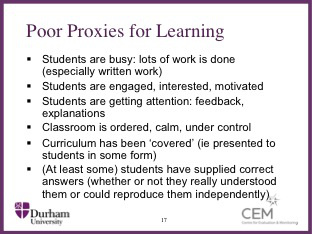
But there’s no point criticising without suggesting an alternative.
Last weekend I promised a constructive alternative to lesson planning for fun, generic activities 
that risk distracting students from thinking about subject content.
The alternative as I see it is to think about activities last of all, and design the entire core content
of the unit and its assessment first. Rather than focusing on individual lessons, we need to refocus on entire units, and the sequencing across and between them. This is a phenomenal amount
of work: Katie Ashford and I spent around 500 hours between us planning and resourcing 
this one unit on Oliver Twist. The topic of my next post will be how we might evaluate such units.
Example curriculum overview: co-planned with Katie Ashford


Example knowledge grid: Katie Ashford’s Oliver Twist

Example lesson questions: Katie Ashford’s Oliver Twist
Example unit sequence: Katie Ashford’s Oliver Twist
Then, and only then, after specifying and sequencing the unit’s knowledge, can we refocus on rigorous, subject-specific tasks that ensure students will be thinking hard about subject content. 
It only makes sense to think about activities once you have considered what knowledge pupils need, and in which order.
What exactly do we mean by rigour? The litmus test for each task is Professor Coe’s simple theory
of learning: will it help students think hard about subject content?

To my mind, rigour in teaching is all about the effective transmission and retention of knowledge
in pupils’ long-term memory: if tasks don’t focus students on subject knowledge,
then they’re not helping students learn.
For now, I just want to focus on the rigorous tasks that I’ve found most effective for instruction
in one subject: my subject, English.
For me, task selection in English depends heavily on which genre – whether poem, play, novel, nonfiction or grammar – and which content – context, author, plot, characters, themes,
language, structure, form or concept – I am teaching.
Nevertheless, here are some (non-exhaustive) tasks that I have found most useful for English, roughly in order of increasing complexity:
Record the lesson, essay or exam question and underline the key words.
Record a checklist of criteria and highlight the key words.
Reading aloud in (irregular) turns, whole-class line-by-line with a ruler.
Whole-class pose-probe-bounce stretch-questioning, no-opt-out.
Read question; then discuss in pairs; then share as a class.
Underline key quotations, highlight key words; then justify choices in pairs.
Write short (even one-word) answers to 20 ‘do now’ written questions.
Sequence these in order (episodes in the plot, characters in importance)
List and collate examples (of characters, themes, concepts) or ideas.
Listen to explanation of a concept with an example/non-example sequence of questions.
Decide whether these (context, plot and character) statements are true or false.
Mindmap and collate examples or ideas for characters, themes or language.
Answer 10 or so plot comprehension questions (& ‘why?’ extensions) in full sentences.
Complete a spelling quiz or test & mark each other’s.
Match vocabulary & definitions/synonyms/antonyms, or vice-versa.
Match dates and events in a contextual timeline.
Categorise examples (of characters, concepts etc) into columns.
Discuss multiple-choice hinge-questions with distractors in pairs.
Discuss hinge-question answers, misconceptions and justifications as a class.
Complete multiple-choice quiz on core content (between 10 and 50 questions).
Free recall test on 10 context or character questions.
Create sentences with examples of concepts.
Annotate model paragraph for content/techniques/criteria.
Give peer-assessment feedback with clear criteria-based questions.
Compare model sentences for the differences in quality of criteria.
Write a sentence with a rigorous conjunction (although, at first glance, overall, ultimately, etc).
Create a free sentence ready to share in pairs and with the class.
Write answers to ‘exit ticket’ questions on concepts or content.
Plan essay ideas in a graphic organiser (grid/matrix/flow diagram).
Summarise the text/plot/characters’ journey in a paragraph.
Find similarities and differences between characters with a focus (first/last impressions).
Summarise the text/plot/characters’ journey in a paragraph.
Compare two introductions and evaluate which works better and why.
Compare two conclusions and evaluate which works better and why.
Write an analytical paragraph on a character, theme or concept.
Write a comparative paragraph on characters, themes, concepts, chapters or poems.
Read each others’ essays and write extension questions.
Redraft the story/poem/biography/speech/essay with corrections and improvements.
Create a (gothic/ghost/etc) short story (e.g. 200 words) or poem (limerick/haiku etc).
Write an informative biography.
Write a persuasive speech.
Convert the speech to notes and memorise it.
Practise, rehearse then deliver the speech.
Write an analytical essay (with context).
Write a comparative essay (with context).
… and there are probably 45 other tasks you could list – and more.
The vital distinction is in connecting these tasks to subject content to ensure students are thinking
as hard as possible for as long as possible about the right things. Ultimately, it is how to connect these still-generic tasks with specific subject content that matters most.
How are these tasks more rigorous than others? They focus pupils’ attention more on thinking carefully about subject content, and they risk less distraction from it. They prioritise retention 
rather than variety for its own sake. Tailor the task to the content, rather than vary activities for pupils’ supposed learning preferences. First things first: first content, then (and only then) activities.
Of course, spelling, grammar and vocabulary are a different story. So are creative writing
and public speaking. They require unique, tailored tasks, beyond the scope of one blogpost.
The point is, activities are best when subject-and-topic-specific, not generic.
From the clock to the compass: the thinking shift is from planning lessons for engaging,
generic activities to selecting and sequencing rigorous, content-led tasks across units. The key difference is the pursuit of the optimal mode of knowledge transmission, retrieval and retention.

The guilty secret of the “outstanding lesson”: a chimera that never existed at all
***
https://pragmaticreform.wordpress.com/2014/02/22/instruction/


You can TCR software and engineering manuals for spontaneously recall – or pass that exam.
I can Turbo Charge Read a novel 6-7 times faster and remember what I’ve read.
I can TCR an instructional/academic book around 20 times faster and remember what I’ve read.
Introduction to Turbo Charged Reading YouTube
A practical overview of Turbo Charged Reading YouTube  
How to choose a book. A Turbo Charged Reading YouTube
Emotions when Turbo Charged Reading YouTube

Advanced Reading Skills Perhaps you’d like to join my FaceBook group ?

Perhaps you’d like to check out my sister blogs:
www.innermindworking.blogspot.com         gives many ways for you to work with the stresses of life
www.ourinnerminds.blogspot.com              which takes advantage of the experience and expertise of others.
www.happyartaccidents.blogspot.com        just for fun.

To quote the Dr Seuss himself, “The more that you read, the more things you will know.
The more that you learn; the more places you'll go.

Monday, 15 February 2016

Vocabulary - though, although, even though, despite, in spite of

Dog rose.


Though, although, even though -- how do we use each of these in English?
In this lesson, I'll explain how we use them, and when exactly they are used in English.
I'll also teach you the meanings and uses of despite and in spite of. Everything
is demonstrated with examples. Test yourself afterwards with the quiz:    http://www.engvid.com/vocabulary-though/

You can TCR music, poetry or self development material for internal knowing.
I can Turbo Charge Read a novel 6-7 times faster and remember what I’ve read.
I can TCR an instructional/academic book around 20 times faster and remember what I’ve read.
Introduction to Turbo Charged Reading YouTube
A practical overview of Turbo Charged Reading YouTube  
How to choose a book. A Turbo Charged Reading YouTube
Emotions when Turbo Charged Reading YouTube

Advanced Reading Skills Perhaps you’d like to join my FaceBook group ?

Perhaps you’d like to check out my sister blogs:
www.innermindworking.blogspot.com          gives many ways for you to work with the stresses of life
www.ourinnerminds.blogspot.com               which takes advantage of the experience and expertise of others.
www.happyartaccidents.blogspot.com         just for fun.

To quote the Dr Seuss himself, “The more that you read, the more things you will know.
The more that you learn; the more places you'll go.”

Friday, 12 February 2016

How To Become A Better Reader

Seepwell.

How To Become A Better Reader
 David Mikics

It's easy to fill your time with Twitter, Tumblr and Facebook, checking email
and glancing at news headlines. But sooner or later you yearn for the pleasure of a good book.
The Internet wants us to click every other minute from site to site.
This habit can stand in the way of an older kind of reading, one that offers real pleasure
and understanding: settling down with a book and getting to know it as well as you can.
Anyone can be a good reader, even in the Internet Age.
Reading better means reading more slowly.
The Net tells us to consume words in small, easy bites, as we dart from one webpage to another.
But slow reading demands time and practice.
When you read, keep your sense of fun, but combine it with the ambition to experience books
as deeply as you can. Make yourself ready for the serious delights that reading can offer:
the unforgettable people and worlds that you can encounter nowhere else.
Here are some rules that will help you with slow reading.
If you enjoy books but feel that there must be more to see, and say, about what you've read,
these rules are for you. They will enable you to become a more able and careful reader,
to know what to do better when you open a book.

BE PATIENT
We must be patient in order to let ourselves listen to a book, to be open to it,
and to give ourselves the time to figure things out.
Reading patiently means looking out for what's small and significant in a book: the details.
"In reading, one should notice and fondle details," said Nabokov.

ASK THE RIGHT QUESTIONS
When you read a book, think of yourself as a detective looking for clues. What are the good leads?        The best questions you can ask are ones that tie the parts of the book together:
what does the beginning have to do with the ending? What are the most telling moments?

IDENTIFY THE VOICE
How does the author of your book speak to the reader? Jane Austen sounds respectable,
but also sly and underhanded; she teases conventional belief, yet argues for it too.
Dueling characters in a novel often have competing voices.

GET A SENSE OF STYLE
Writers sound very distinct from one another on the page.
Through style, the author announces his or her inmost self.
The labyrinthine Henry James couldn't be more different from the spare, uncanny Kafka.

NOTICE BEGINNINGS AND ENDINGS
How often do you look back to the beginning of a book after finishing it? Well, you ought to.
The structure of a book tells you how it thinks, and openings and conclusions 
are the backbone of structure.

IDENTIFY SIGNPOSTS
Signposts are key words, key images, key sentences or passages. Think of reading as a kind of travel: signposts help you map your journey. Works like Conrad's "Heart of Darkness"
or Virginia Woolf's "The Death of the Moth" center on a signpost image.

USE THE DICTIONARY
Take the time to look up a few words that interest you, even if you already know their meaning,
in a good unabridged dictionary like the American Heritage or, best of all,
the Oxford English Dictionary. You will enrich your reading experience beyond measure.

TRACK KEY WORDS
Key words allow you to trace the argument of a book: justice in Plato,
love and ambition in Stendhal, work in Robert Frost. Austen's titles let you know straight off
what her key words will be: "Pride and Prejudice," "Persuasion", "Sense and Sensibility."

FIND THE AUTHOR'S BASIC THOUGHT
This is most challenging of the rules: press yourself to discover the fundamental question
that animates an author. Imagine someone asking, "what does that book you're reading
want to tell you?" and try to come up with the fullest, most interesting answer.

BE SUSPICIOUS
All too often, when we start reading, we decide quickly which characters we like
and which we dislike, who's evil and who's good. But the truth is more complex:
every good author wants to frustrate your desire for simple meaning, so that you will suspect
your first reactions and find a deeper layer of meaning beneath those initial responses.

FIND THE PARTS
Try to understand how a book is organized, even if you've only read a few pages of it so far.
Draw a mental map of the book's sections; see how it progresses from one phase to the next.

WRITE IT DOWN
You'll find it helpful to jot down your impressions in the book's margins, or in a notebook.
Even if you only do this a few times as you read a book, you can start a conversation with the author by summing up your reactions.

EXPLORE DIFFERENT PATHS
Revision is one of the writer's basic tools, but it's also useful for readers.
Imagine how an author might have ended a work differently, or changed a crucial moment
in the plot. You'll be thinking with the author, gaining insight into his or her decisions.

FIND ANOTHER BOOK
Every worthwhile book proposes a world of its own, and instigates a lively debate with other books. Homer's "Iliad" glorifies the heroes of the battlefield;
Tolstoy's "War and Peace" gives a darker, more doubtful picture of them.
Measuring one great author against another will enlarge your reading of both.
David Mikics is the author of the new book Slow Reading in a Hurried Age.
http://www.huffingtonpost.com/david-mikics/how-to-become-a-better-re_b_4065443.html

You can TCR specialist and language dictionaries that are spontaneously accessed.
I can Turbo Charge Read a novel 6-7 times faster and remember what I’ve read.
I can TCR an instructional/academic book around 20 times faster and remember what I’ve read.
Introduction to Turbo Charged Reading YouTube
A practical overview of Turbo Charged Reading YouTube  
How to choose a book. A Turbo Charged Reading YouTube
Emotions when Turbo Charged Reading YouTube

Advanced Reading Skills Perhaps you’d like to join my FaceBook group ?

Perhaps you’d like to check out my sister blogs:
www.innermindworking.blogspot.com         gives many ways for you to work with the stresses of life
www.ourinnerminds.blogspot.com              which takes advantage of the experience and expertise of others.
www.happyartaccidents.blogspot.com        just for fun.

To quote the Dr Seuss himself, “The more that you read, the more things you will know.
The more that you learn; the more places you'll go.”    

Tuesday, 9 February 2016

Why aren’t rewards working?


“Everybody has won, and all must have prizes.”
Lewis Carroll’s Dodo, Alice in Wonderland

Reward systems hold the promise of digital tracking of students’ effort and decisions in lessons.
But sometimes they backfire, as this teacher points out:
When the new system was introduced, one of my pupils shouted:
‘You get points just for showing up! What does that teach us?’ Looking later at the stats,
I noticed that the top five reward earners were the worst behaved students in the entire school. Prizes were simply being used as a way of getting kids to do what they should be doing anyway, rather than to reward students for going the extra mile. The attitude was ‘oh well,
I’ll get more later anyway, I can’t be bothered to answer these questions, so I won’t’. That’s when
it struck me: giving out unmerited rewards all the time actually legitimised their poor behaviour.”
 Economics


A couple of stories from economic research can enlighten us as to why incentives backfire:
‘When people were given a small stipend for donating blood rather than simply praised
for their altruism, they actually donated less blood. The stipend turned a noble act of charity
into a painful way to make money, and it simply wasn’t worth it.’
‘Nursery schools started fining parents who turned up late to pick up their children at 4pm.
The result was striking: the number of late pick-ups more than doubled.’

There are two main types of incentives: economic, and social or moral. The fine and the stipend backfired because they substituted an economic incentive for a moral incentive.

Stephen Covey calls the carrot and the stick approach ‘animal psychology’,
‘the great jackass technique of human motivation’.
Daniel Pink also exposes the flaws of carrots and sticks: ‘Rewards often don’t help and often harm: they end up giving us less of what we want: they extinguish intrinsic motivation,
diminish performance, crush creativity and crowd out good behaviour.’ 
Pink asks: ‘does education put too great an emphasis on extrinsic rewards?
We want pupils to develop their intrinsic motivation.
Which extrinsic factors build intrinsic motivation? For many of us at school,
our parents’ expectations, encouragement, recognition, and reinforcement over extended periods
of time helped us internalise our own intrinsic motivation.
But not all kids can rely on this from home. Some kids arrive at school without it, demotivated.
It’s an unlevel playing field within and between schools.
So should school systems compensate for that and level the playing field?
Or does this result in the worst behaved kids getting the most rewards, rewarding disruption
and disincentivising effort? Schools must avoid the perverse incentives
whereby a kid who usually doesn’t try gets a reward for trying a little, once,
and all the kids that try hard all the time get nothing.
If we give too many rewards, kids learn attendance and self-discipline only has value
for these rewards. Giving out sweets and stickers can actually diminish motivation.
Yet some schools are spending up to £30,000 on such rewards as ipads, laptops and games consoles.

Psychology
Psychological studies to demonstrate the ‘overjustification’ effect were conducted over 40 years ago in 1971 by Edward Deci. The findings were replicable: once an activity is associated with
an external reward, people are less inclined to participate in the activity without a reward present.
Deci summarises the lessons of self-determination theory: ‘Do rewards motivate people?
Absolutely. They motivate people to get rewards. When people use rewards to motivate,
that’s when they’re demotivating. The less salient they are made, the better.’
In Understanding Motivation and Emotion, Jonmarshall Reeve corroborates this:
“People use rewards expecting to gain the benefit of increasing another person’s motivation
and behaviour, but in so doing, they often incur the unintentional and hidden cost of
undermining that person’s intrinsic motivation toward the activity.”
There is a large body of research on intrinsic motivation – thanks to Laura McInerney
for signposting me to it. Here is a small sample of hundreds of articles on this,
which exposes a striking paradox:
In a self-fulfilling prophecy effect, teachers’ beliefs about students’ motivation affectedtheir behaviour towards students and their students’ intrinsic motivation. 
Tangible rewards substantially undermine intrinsic motivation, especially for school-age children;
it’s more important to focus on how to facilitate intrinsic motivation,
ensuring tasks are optimally challenging.
Teachers are much more controlling with students they believed to be not motivated. 
Teachers are much more autonomy-supporting when they expect them to be intrinsically motivated.
Daniel Pink popularised this research in his book, 
Drive: the surprising truth about what motivates us. 
Although it is mainly aimed at the adult workplace (as much of the self-determination research
is on University-age students rather than school-age pupils), it does draw implications for schools. He asks whether ‘we’re bribing students into compliance instead of challenging them into mastery.’
Pink argues that there is a mismatch between what the science says and what schools do.
He says what really motivates us is mastery, purpose and autonomy.
Deci‘s psychological research suggests competence, relatedness and autonomy are the key ingredients, although to my knowledge these are nowhere in the research split out and measured for their relative importance.
I’d build on this and suggest that pupils develop their intrinsic motivation
through three nutrients: mastery, responsibility and relationships. 
I think responsibility is a more foundational nutrient for young primary and secondary school pupils than autonomy; that you can’t be truly autonomous until you’ve achieved responsibility
for your choices and their consequences.
So what might schools do about intrinsic motivation and its nutrients?
The moral of the story from social psychology and behavioural economics is
that we might start by limiting perverse economic incentives with unintended consequences,
instead applying social incentives. To give a small example, a signed postcard or personal phonecall home connects teachers, tutors and parents in a way that sweets or ipads do not.
The most motivating factors are getting genuinely better at something,
and getting recognised by those around us. Mastery and relationships motivate most.
Developing internal responsibility is much harder, but much more enduring than giving out prizes.
I wrote last week about the scientific evidence on developing self-control and willpower.
That research suggests that building self-esteem is a red herring, and that building self-discipline
is much more important. The conundrum is that teachers entrust more responsibility
to already motivated pupils, whilst denying motivating responsibility to those they expect
to be demotivated.
Over the next five weeks,
I’ll suggest five ideas that schools might use to find their way out of this conundrum.

You can TCR software and engineering manuals for spontaneously recall – or pass that exam.
I can Turbo Charge Read a novel 6-7 times faster and remember what I’ve read.
I can TCR an instructional/academic book around 20 times faster and remember what I’ve read.
Introduction to Turbo Charged Reading YouTube
A practical overview of Turbo Charged Reading YouTube  
How to choose a book. A Turbo Charged Reading YouTube
Emotions when Turbo Charged Reading YouTube

Advanced Reading Skills Perhaps you’d like to join my FaceBook group ?

Perhaps you’d like to check out my sister blogs:
www.innermindworking.blogspot.com          gives many ways for you to work with the stresses of life
www.ourinnerminds.blogspot.com               which takes advantage of the experience and expertise of others.
www.happyartaccidents.blogspot.com         just for fun.

To quote the Dr Seuss himself, “The more that you read, the more things you will know.
The more that you learn; the more places you'll go.

Saturday, 6 February 2016

Assessing Reading Proficiency


Assessing Reading Proficiency

Reading ability is very difficult to assess accurately. In the communicative competence model,
a student's reading level is the level at which that student is able to use reading
to accomplish communication goals. This means that assessment of reading ability
needs to be correlated with purposes for reading.

Reading Aloud
A student's performance when reading aloud
is not a reliable indicator of that student's reading ability.
A student who is perfectly capable of understanding a given text when reading it silently
may stumble when asked to combine comprehension with word recognition and speaking ability 
in the way that reading aloud requires.
In addition, reading aloud is a task that students will rarely, if ever, need to do
outside of the classroom. As a method of assessment, therefore, it is not authentic:
It does not test a student's ability to use reading to accomplish a purpose or goal.
However, reading aloud can help a teacher assess whether a student is "seeing" word endings
and other grammatical features when reading. To use reading aloud for this purpose,
adopt the "read and look up" approach: Ask the student to read a sentence silently
one or more times, until comfortable with the content, then look up and tell you what it says.
This procedure allows the student to process the text, and lets you see the results
of that processing and know what elements, if any, the student is missing.

Comprehension Questions
Instructors often use comprehension questions to test whether students have understood
what they have read. In order to test comprehension appropriately, these questions need
to be coordinated with the purpose for reading. If the purpose is to find specific information, comprehension questions should focus on that information.
If the purpose is to understand an opinion and the arguments that support it,
comprehension questions should ask about those points.
In everyday reading situations, readers have a purpose for reading before they start.
That is, they know what comprehension questions they are going to need to answer
before they begin reading. To make reading assessment in the language classroom
more like reading outside of the classroom, therefore, allow students to review
the comprehension questions before they begin to read the test passage.

Finally, when the purpose for reading is enjoyment, comprehension questions
are beside the point. As a more authentic form of assessment, have students talk
or write about why they found the text enjoyable and interesting (or not).

Authentic Assessment
In order to provide authentic assessment of students' reading proficiency,
a post-listening activity must reflect the real-life uses to which students
might put information they have gained through reading.
It must have a purpose other than assessment
It must require students to demonstrate their level of reading comprehension
by completing some task
To develop authentic assessment activities, consider the type of response
that reading a particular selection would elicit in a non-classroom situation.
For example, after reading a weather report, one might decide what to wear the next day;
after reading a set of instructions, one might   repeat them to someone else;
after reading a short story, one might discuss the story line with friends.
Use this response type as a base for selecting appropriate post-reading tasks.
You can then develop a checklist or rubric that will allow you to evaluate
each student's comprehension of specific parts of the text.

 http://www.nclrc.org/essentials/reading/assessread.htm

You can TCR specialist and language dictionaries that are spontaneously accessed.
I can Turbo Charge Read a novel 6-7 times faster and remember what I’ve read.
I can TCR an instructional/academic book around 20 times faster and remember what I’ve read.
Introduction to Turbo Charged Reading YouTube
A practical overview of Turbo Charged Reading YouTube  
How to choose a book. A Turbo Charged Reading YouTube
Emotions when Turbo Charged Reading YouTube

Advanced Reading Skills Perhaps you’d like to join my FaceBook group ?

Perhaps you’d like to check out my sister blogs:
www.innermindworking.blogspot.com         gives many ways for you to work with the stresses of life
www.ourinnerminds.blogspot.com              which takes advantage of the experience and expertise of others.
www.happyartaccidents.blogspot.com        just for fun.

To quote the Dr Seuss himself, “The more that you read, the more things you will know.
The more that you learn; the more places you'll go.”    

Wednesday, 3 February 2016

Learn English Grammar: Modals - "could" or "should"?

Cornflower.


Expectation is what we think could or should happen.
But COULD and SHOULD are not the same!
This important grammar lesson will teach you how to use these modals correctly,
like a native English speaker. You SHOULD take the quiz to test yourself!
http://www.engvid.com/learn-english-g...

TRANSCRIPT
What's up, Mr. E? We could be finished in 20 minutes, is that right?
Oh, hi. James, from EngVid. Mr. E and I were talking about something.
We're having a little disagreement. Well, not a disagreement, but a conversation.
I think this lesson could be about five, ten minutes.
He said it should be 15. That's a standard lesson length.
What's the difference? I don't know.
Why don't we go to the board and find out?
Module
If this looks familiar, it should be. This is the -- "it should be". See?
This is the second lesson of modals that we're doing.
(As a born English speaker I have never heard of the word ‘Modal’ and I had to look up its definition;
which is different to the word of my choice ‘module’ which has the wrong meaning.  
Module means: a single unit of the whole, or a part or section of the whole course/thing.)
The first one we did was excuses. Yeah? You could've taken that lesson.
If you haven't, close this one down; watch that; and come back to this one.
This one is actually on expectation. You know? Sometimes, people make excuses for not doing stuff. And other times, our expectations are what we think should happen in the future or could happen. This lesson will help you find out how native speakers use modals in a little different way than
you're used to or in the usual grammar setting. Okay? So let's go to the board.

Once again, quickly we'll go over it. What do modals do?
Well, modals talk about obligations or possibilities, right? Possibility indicates future.
Future. When we talk about what's possible. An obligation is what you should do.
So if you mix those together, that's what an expectation is -- is what is possible
and what we think people or things should do or happen. Right? Your obligation or the obligation. But let's take a look at this here. Let's go to the board, okay?

First of all, when we talk about modals, which I've just done -- you know,
they express future possibility or obligations. Let's look at the verb "to be" or the Be verb.
The Be verb is about relative truth. And you're probably going to say to me,
"What the hell is relative truth?" Well, relative truth is means somebody believes it's true,
and it depends on where you sit. Right now, you're looking at me, and I'm a tall guy. I'm skyscraper tall. I'm a giant. But only if you're this tall. If you can't see me, it's because I'm a very tiny little man looking up at Big James. Understand? So relatively speaking, if you're this big, anything this big is big. But anything this big, big, big, big, big, big is bigger than this. Understand?
"Relative" means it depends on who is looking at it, right? If you're 60, then 40 is young.
If you're 40 years old, then 20 is young. And if you're 10, they're all old, okay?
Relative truth. Where do you sit?

So that's what the Be verb means. So once we put a modal, okay, with the Be verb, it changes it.
It gives it a different meaning. And what we want to look at now is what does that mean,
this change, or how does it change it?
And the video before, I mentioned, we noticed how we use it for excuses.
In this one, we're going to see how we think the future should be or could be, all right? Let's go.

So what is -- the modal should mean? Well, "should" is what we usually think -- "should" is what
is right, okay? We think it is right or probable, most likely to happen, or the correct or right thing
to do. That's why we use it as an advice modal. "You should go to school.
You should eat your dinner. You should shut up." Okay? We use it as advice. The last one is strong advice. Okay? And "could" is possible. What's possible? You could be talking to me live
if you come to Canada. Or you could be dreaming this whole thing. Press reset
and see if that's the case. But no. "Could" is what's possible -- possible to happen, okay?

Now, if you add this Be verb to "should", we get this particular thing.
See, here's the Be verb because Be is believe, remember? Your perspective; what you believe.
"I should + be -- I believe this is right or probable." "You should be a better student. I believe this. And I think it's possible -- probable or right. If you studied harder" -- by saying "studied harder",
I think this is what is probable or the correct thing. Right?

But "possible", which is similar, but not the same -- let's not forget -- it's what's possible.
"I believe this is possible." "I believe we could be the greatest nation on Earth", says Obama.
He should've said something else. Notice I didn't say "should be";
I said "shoulda". Different. Anyway.

So here, we've got what is possible versus what is probable. It seems simple and easy, and it is.
So why don't we just use one? And there's a reason for it. Remember, I said this one has "probable" and "right"? And that's with "should"? Well, when people say "should" in English -- like,
"you should be" versus "could be" -- what is actually we think is more accurate
or more likely to happen.


Modal       I’m a born English speaker and this word is new to me!
ADJECTIVE
relating to mode or form as opposed to substance.
Grammar: of or denoting the mood of a verb.
Statistics: relating to a value that occurs most frequently in a given set of data.
Music: of or denoting music using melodies or harmonies based on modes
             other than the ordinary major and minor scales.
NOUN
Grammar: a modal word or construction.
Powered by Oxford Dictionaries · © Oxford University Press · Translation by Bing Translator

Should’ can be used instead of ‘have to’, or ‘must’ or ‘ought to
I must obey the law. This is strong. 
should obey the law. This is not as strong.
I ought to obey the law. This is weak.

Could’ can be used instead of: might, can, possibly will, may well, may perhaps, may possibly,
I could/it is possible that I will go to Canada for my next holiday.
I might go to Canada for my next holiday. I may go to Canada for my next holiday.
I probably will go to Canada for my next holiday, if I can afford it.

You can TCR music, poetry or self development material for internal knowing.
I can Turbo Charge Read a novel 6-7 times faster and remember what I’ve read.
I can TCR an instructional/academic book around 20 times faster and remember what I’ve read.
Introduction to Turbo Charged Reading YouTube
A practical overview of Turbo Charged Reading YouTube 
How to choose a book. A Turbo Charged Reading YouTube
Emotions when Turbo Charged Reading YouTube

Advanced Reading Skills Perhaps you’d like to join my FaceBook group ?

Perhaps you’d like to check out my sister blogs:
www.innermindworking.blogspot.com         gives many ways for you to work with the stresses of life
www.ourinnerminds.blogspot.com              which takes advantage of the experience and expertise of others.
www.happyartaccidents.blogspot.com        just for fun.

To quote the Dr Seuss himself, “The more that you read, the more things you will know.
The more that you learn; the more places you'll go.”