Showing posts with label learning. Show all posts

Thursday, 7 July 2016

The Cult of Outstanding™: the problem with ‘outstanding’ lessons

Knap weed, slender and creeping thistle.

The Cult of Outstanding™: the problem with ‘outstanding’ lessons

First of all I need to come clean. Up until pretty recently I was a fully paid up member of
the Cult of Outstanding™. Last January I considered myself to be a teacher at the height
of my powers. In the spirit of self-congratulation I posted a blog entitled Anatomy of an Outstanding Lesson in which I detailed a lesson which I confidently supposed was the apotheosis
of great teaching, and stood back to receive plaudits. And indeed they were forthcoming.
I was roundly congratulated and felt myself extraordinarily clever.
And then Cristina Milos got in touch to tell me that there was no such thing as an outstanding lesson. I was, she patiently pointed out, deluding myself. When I sputtered my objections she directed me to a video of Robert Bjork explaining the need to dissociate learning from performance.
Now no one enjoys being told they’re a fool, but I have to say that I’m profoundly grateful
to Cristina for not pulling her punches; nothing else has had anywhere near the impact
on my thinking about teaching and learning. When you start thinking in this way,
it becomes increasingly obvious just how little we know and understand about what we do.

The more I’ve read and the deeper I’ve delved into this, the more convinced I’ve become
that in our efforts to cast teachers in the mould supposedly preferred by Ofsted we are unwittingly, but actively, undermining our pupils’ ability to learn. Understandably, this is not a popular message.

A lot of very influential people have got an awful lot invested in the belief
that the pedagogical methodologies popularly understood to result in
‘outstanding’ lessons are the right way to teach.
In fact it may well be easier for a rich man to pass through the eye of a needle than for an
Ofsted inspector, an education consultant or a school leader to admit that they’ve been wrong.

But are they wrong? So far this is just a piece of polemic and can be easily dismissed
as the ravings of a loon. Well, I think you’d agree that most teachers in most schools
are expected to teach lessons in which students make visible progress.
Although the past year or so has seen the pernicious myth of ‘progress in 20 minutes’
rightly debunked, as a profession we still believe that the best lessons are those in which pupils
are learning. Now as a whole raft of academics have proved (at least to my mind) learning is, in fact, invisible. Judging the effectiveness of teaching by assessing what pupils can do during a lesson
is arrant foolishness. It would be like me telling you that the capital of Poland was Warsaw
and then asking, a few minutes later, what the capital of Poland was. What’s that? Warsaw, you say? Oh jolly good. Marvellous progress. This is an obviously risible example
but not really so very different from the literally thousands of lessons I’ve taught
in which I’ve shown pupils how to do something and then proudly watched them do it themselves. They are merely responding to cues.
They may have learned something, but this can only be inferred from their performance.
Now the truly mind-bending bit of all this is that sometimes (often?) current performance
is not only a poor indication of learning, it actually seems to prevent it. When we design lessons that boost pupils’ performance, the net result is that we are retarding the likelihood that they will learn. Conversely “Conditions that induce the most errors during acquisition are often the very conditions that lead to the most learning!” (Bjork 2013) So are all those slickly outstanding lessons
we’ve venerated for so long really just fluff and nonsense?
Lessons which are generally judged to be outstanding are characterised by pupils
being visibly engaged and ‘getting it’. Ofsted’s criteria for outstanding teaching and learning
include the following:
Sustained & rapid progress
Consistently high expectations
Excellent subject knowledge
Systematic, accurate assessment
Well judged, imaginative teaching strategies
Sharply focused & timely support
Enthusiasm, participation & commitment
Resilience, confidence & independence
Frequent & consistently high quality feedback
Engagement, courtesy, collaboration & cooperation
In order to thoroughly expose the Cult of Outstanding™,
we might do well to investigate each of these criteria in turn.

Sustained & rapid progress
I’ve already written extensively about the problems with progress so let me summarise
by asking this: if we do something really quickly is it likely to last? I contend that rapid and sustained progress are mutually exclusive: they cancel each other out. You can have one or the other.
We have to choose and I’d strongly recommend sustained progress. The problem is that the route
to sustained progress is deeply counter-intuitive. We’re all a lot more comfortable with the idea
of making rapid progress because it ‘feels right’. But there’s a significant body of research
which suggests that slowing performance and increasing the errors made during instruction
has a significant impact on our ability to retain and transfer skills and knowledge.
Simply put, we learn better by struggling. But this is not what happens in an outstanding lesson where pupils are expected to demonstrate rapid progress and not look confused
as they grapple with challenging concepts.

Consistently high expectations
On the face of it you’d think I would have little to argue against here.
And on the face of it, you’d be right. But consistently high expectations of what?
If our expectation as teachers is that pupils perform to a high level only in our lessons
then we may will be guilty of engineering a situation which makes it harder for them to retain
and transfer what we’re teaching. This leads to a culture where it becomes routine for pupils
not to remember or be able to apply the basics. Consider this: in a Year 11 English lesson,
we read an article about Barrack Obama taking a 5% pay cut to show support for the plight
of the American economy. We decided to award him a nicely rounded salary of $150,000
and calculate what this 5% reduction might represent. I was appalled when the class,
which contained some very bright mathematicians, signally failed to work out what is, even for me,
a pretty simple sum. I’m fairly sure the same thing goes on when students I know for a fact can spell and paragraph accurately in my lessons suddenly lose this ability in, say, geography or science.

Excellent subject knowledge
OK, you got me. Having expert subject knowledge is highly desirable and likely to result
in pupils making significant gains in their learning. In particular, it pays teachers to understand
the likely mistakes and misconceptions pupils are likely to make in a given subject.
If these mistakes are anticipated and headed off before they become ingrained
then a great deal of harm is avoided. Naturally it’s not sufficient to merely have great
subject knowledge, but it is necessary and your kids ain’t  gonna get very far if you’ve not got it.

Systematic, accurate assessment
Again, this seems obvious doesn’t it? How can systematic and accurate assessment be a bad thing? The short answer is that it can’t. But the problem is that very little assessment is accurate
and systematic in the right way. Most mark schemes are highly subjective and do little to encourage accuracy. Daisy Christodoulou has written eloquently about what she calls ‘the adverb problem‘
and this is something of which we should be ever mindful.
Our assessment is a lot more inaccurate and vague than we’d like to admit.

Well judged, imaginative teaching strategies
Of course well-judged teaching strategies are brilliant. But if we believe that improving pupils’ performance is the desired outcome then it’s highly unlikely that the strategies we select
will be well-judged. It’s certainly very rare for a lesson to be judged outstanding if pupils
are still struggling by the end of the lesson; this is normally judged inadequate.
But if sustained progress is our goal then neat resolutions and slick performances
will undermine our aim. And we don’t really mean ‘imaginative’, do we?
What we mean is ‘conforming to a fairly narrow set of expectations
of what constitutes good teaching’. And that just isn’t the same.

Sharply focused & timely support
Providing effective support is, of course, highly desirable, but too much support
will create learned helplessness. Also we often support pupils because we’re obsessed
with improving their performance. But there’s nothing inherently wrong with struggle,
in fact it’s often essential for information to wend its way from working to long term memory.
So why are we so squeamish about children being stuck? We’d do better sometimes to set out
our stall to celebrate what’s hard and damn what comes easily. There’s a toxic trend in our society
to dismiss hard work as the preserve of thickos and plodders. It’s in our language: ‘Hard luck!’, ‘
Easy does it!’ All this sharply focussed support may well be eroding the confidence and resilience
we so desire in our students. The point of scaffolding is that it must be removed.
The problem with outstanding lessons is that they rarely devote the time necessary
for effective explanations or modelling (see below) for fear that the teacher
will be accused on talking for too long.

Enthusiasm, participation & commitment
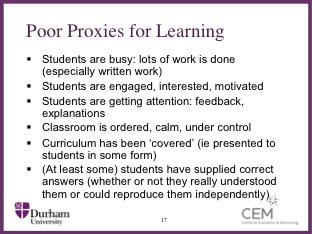
These, along with engagement, are the very stuff of Robert Coe’s ‘poor proxies for learning’.
These things are lovely and certainly sociably desirable, but the tell us nothing about the quality
of pupils’ learning. It’s relatively well-known that doodling can increase your retention
and in the past I’ve taught children whose apparent attention is lessons is minimal
and yet they learn. One boy I shepherded through GCSEs spent 2 years building piles of rubbers
only to get an A*! We can, and should, insist on good behaviour because the alternative is horrible. But we must be informed and honest enough to acknowledge that observation feedback like
‘that boy at the back was off-task for 3 minutes’ is utterly meaningless.

Resilience, confidence & independence
I’m all for pupils being resilient, confident and independent. Who wouldn’t be?
The problem here is that we’ve got ourselves into the perfectly understandable muddle
of believe that independent learning will result in independence. It doesn’t; independent learning actually makes pupils more dependent. If we really value independence and want our pupils
to be confident and resilient then we’re much better off teaching them.
I’ve written extensively about the teaching sequence for developing independence, but just to recap, the process is broken down into 4 stages:
Explaining – you can’t think about what you don’t know so if we want our pupils
to do anything interesting or creative we must give them the vocabulary
 and background knowledge required to explore a subject.
Modelling – no one is ever going to get good at anything unless they go through the process
of deconstructing high quality examples and then ‘seeing’ the expert thought processes
which go into creating an expert example. The road to hell is paved with vague success criteria.
Scaffolding – once pupils have had new concepts explained and had great examples modelled
then they’re ready to have a go. Our job is to make sure that everyone is challenged to do something they will find difficult and help them deal with the frustration of not being able to get it.
Practising – pupils are now ready to work independently. Our role is to be aware of the fact
that practice doesn’t make perfect, practice makes permanent. We must be vigilant about
the mistakes pupils are likely make and prevent them prevent them becoming embedded.

Frequent & consistently high quality feedback
Yet again this appears entirely desirable. That is until we examine the staggering weight of research that suggests that delaying and reducing feedback, while having a negative impact of short term performance gains, tends to boost long term retention and transfer.
This leads us, inevitably, down a rabbit hole of trying to determine exactly what ‘high quality’ feedback might be. Is it high quality if it visibly supports pupils’ performance in the classroom?
Or is it high quality if it means that they’re more likely to pass an exam? This issue is that one of these is easy to check for during an observation and the other isn’t. Guess which we tend to prefer?
Contrary to what almost everyone else would have us believe, Bjork tell us this: “Numerous studies—some of them dating back decades—have shown that frequent and immediate feedback can, contrary to intuition, degrade learning.” This is an earth shattering bombshell
and goes completely against the grain. I intend to devote my next post to dealing with this at length.

Engagement, courtesy, collaboration & cooperation
We’ve already dealt with engagement above and no right thinking teacher would object
to politeness except to say that it has very little bearing on learning. But collaboration
and cooperation betray a preference for group work. There’s a time and a place for group work:
it slots in neatly to the scaffolding phase of teaching. But the idea that all lessons should contain collaborative or cooperative learning is preposterous.
Thank goodness that the subsidiary guidance to inspectors added in December 2013 confirms this:
Do not expect to see ‘independent learning’ in all lessons and do not make the assumption that
this is always necessary or desirable. On occasions, too, pupils are rightly passive rather than active recipients of learning. Do not criticise ‘passivity’ as a matter of course and certainly not unless
it is evidently stopping pupils from learning new knowledge or gaining skills and understanding.
It’s become abundantly clear to me that what might appear to be passive may well conceal
a vigorous and seismic inner turmoil that heralds real learning. So the next time you think
you’ve seen an outstanding lesson, think again. There’s no such thing! We can certainly have outstanding teaching – it’s the preserve of those teachers who get consistent and startling results, where students really learn. The received wisdom on what an outstanding lesson is,
actively obstructs outstanding teaching. We all need the humility to accept that our preferences
and biases are just that: ours. They do not lead to better learning. And further, it is my considered and contentious opinion that the pursuit of outstanding lessons has done more to damage education than any of the more obvious goonery like VAK and Brain Gym that we’ve had to put up with
over the years.

The fact that Ofsted appear to be officially distancing themselves from some of the more deluded facets of Outstanding™ lessons can only be good news. But that still leaves us with a situation
where most inspectors and school leaders have got where they are on the strength of their ability
to dance the rapid progress jig.
Will they be able to admit the possibility that they were hoodwinked by the Cult of Outstanding?
I’m sure you’ll have an opinion on all this and I look forward to discussing it in the comments below.
Related posts
Don’t trust your gut: a little bit more o the problem with grading lessons
Deliberately difficult: why it might be better to make learning harder

http://www.learningspy.co.uk/learning/cult-outstanding/

Turbo Charged Reading: Read fast>>>Remember all>>>Years later
Contact M’reen at: read@turbochargedreading.com

You can TCR specialist and language dictionaries that are spontaneously accessed.
I can Turbo Charge Read a novel 6-7 times faster and remember what I’ve read.
I can TCR an instructional/academic book around 20 times faster and remember what I’ve read.
Introduction to Turbo Charged Reading YouTube
A practical overview of Turbo Charged Reading YouTube 
How to choose a book. A Turbo Charged Reading YouTube
Emotions when Turbo Charged Reading YouTube

Advanced Reading Skills Perhaps you’d like to join my FaceBook group ?

Perhaps you’d like to check out my sister blogs:
www.innermindworking.blogspot.com        gives many ways for you to work with the stresses of life
www.ourinnerminds.blogspot.com              which takes advantage of the experience and expertise of others.
www.happyartaccidents.blogspot.com       just for fun.

To quote the Dr Seuss himself, “The more that you read, the more things you will know.
The more that you learn; the more places you'll go.”

Thursday, 18 February 2016

The Clock & The Compass: Rethinking Instruction

Common Mallow.

The Clock & The Compass: Rethinking Instruction
Joe Kirby
 
We should focus instruction on rigorous, content-led, subject-specific tasks
that ensure students think hard about subject content.

It is my belief that we need to change the way we think about planning and instruction.
In his book First Things First, Stephen Covey suggests changing the way we think about time:
from the clock to the compass. Clock thinking is working out how to get more and more things done. Compass thinking is working out which things to focus on in the first place.
In teaching, it strikes me that we are stuck in clock thinking. We think about planning
and evaluating individual, ideally ‘outstanding’ lessons. This pursuit of the ‘outstanding lesson’
is a chimera, spawning innumerable INSETs and entire book series.
Is the road to hell paved with outstanding intentions?
As Professor Coe has pointed out, this risks focusing our attention on poor proxies for learning:
But there’s no point criticising without suggesting an alternative.
Last weekend I promised a constructive alternative to lesson planning for fun, generic activities 
that risk distracting students from thinking about subject content.
The alternative as I see it is to think about activities last of all, and design the entire core content
of the unit and its assessment first. Rather than focusing on individual lessons, we need to refocus on entire units, and the sequencing across and between them. This is a phenomenal amount
of work: Katie Ashford and I spent around 500 hours between us planning and resourcing 
this one unit on Oliver Twist. The topic of my next post will be how we might evaluate such units.
Example curriculum overview: co-planned with Katie Ashford


Example knowledge grid: Katie Ashford’s Oliver Twist

Example lesson questions: Katie Ashford’s Oliver Twist
Example unit sequence: Katie Ashford’s Oliver Twist
Then, and only then, after specifying and sequencing the unit’s knowledge, can we refocus on rigorous, subject-specific tasks that ensure students will be thinking hard about subject content. 
It only makes sense to think about activities once you have considered what knowledge pupils need, and in which order.
What exactly do we mean by rigour? The litmus test for each task is Professor Coe’s simple theory
of learning: will it help students think hard about subject content?

To my mind, rigour in teaching is all about the effective transmission and retention of knowledge
in pupils’ long-term memory: if tasks don’t focus students on subject knowledge,
then they’re not helping students learn.
For now, I just want to focus on the rigorous tasks that I’ve found most effective for instruction
in one subject: my subject, English.
For me, task selection in English depends heavily on which genre – whether poem, play, novel, nonfiction or grammar – and which content – context, author, plot, characters, themes,
language, structure, form or concept – I am teaching.
Nevertheless, here are some (non-exhaustive) tasks that I have found most useful for English, roughly in order of increasing complexity:
Record the lesson, essay or exam question and underline the key words.
Record a checklist of criteria and highlight the key words.
Reading aloud in (irregular) turns, whole-class line-by-line with a ruler.
Whole-class pose-probe-bounce stretch-questioning, no-opt-out.
Read question; then discuss in pairs; then share as a class.
Underline key quotations, highlight key words; then justify choices in pairs.
Write short (even one-word) answers to 20 ‘do now’ written questions.
Sequence these in order (episodes in the plot, characters in importance)
List and collate examples (of characters, themes, concepts) or ideas.
Listen to explanation of a concept with an example/non-example sequence of questions.
Decide whether these (context, plot and character) statements are true or false.
Mindmap and collate examples or ideas for characters, themes or language.
Answer 10 or so plot comprehension questions (& ‘why?’ extensions) in full sentences.
Complete a spelling quiz or test & mark each other’s.
Match vocabulary & definitions/synonyms/antonyms, or vice-versa.
Match dates and events in a contextual timeline.
Categorise examples (of characters, concepts etc) into columns.
Discuss multiple-choice hinge-questions with distractors in pairs.
Discuss hinge-question answers, misconceptions and justifications as a class.
Complete multiple-choice quiz on core content (between 10 and 50 questions).
Free recall test on 10 context or character questions.
Create sentences with examples of concepts.
Annotate model paragraph for content/techniques/criteria.
Give peer-assessment feedback with clear criteria-based questions.
Compare model sentences for the differences in quality of criteria.
Write a sentence with a rigorous conjunction (although, at first glance, overall, ultimately, etc).
Create a free sentence ready to share in pairs and with the class.
Write answers to ‘exit ticket’ questions on concepts or content.
Plan essay ideas in a graphic organiser (grid/matrix/flow diagram).
Summarise the text/plot/characters’ journey in a paragraph.
Find similarities and differences between characters with a focus (first/last impressions).
Summarise the text/plot/characters’ journey in a paragraph.
Compare two introductions and evaluate which works better and why.
Compare two conclusions and evaluate which works better and why.
Write an analytical paragraph on a character, theme or concept.
Write a comparative paragraph on characters, themes, concepts, chapters or poems.
Read each others’ essays and write extension questions.
Redraft the story/poem/biography/speech/essay with corrections and improvements.
Create a (gothic/ghost/etc) short story (e.g. 200 words) or poem (limerick/haiku etc).
Write an informative biography.
Write a persuasive speech.
Convert the speech to notes and memorise it.
Practise, rehearse then deliver the speech.
Write an analytical essay (with context).
Write a comparative essay (with context).
… and there are probably 45 other tasks you could list – and more.
The vital distinction is in connecting these tasks to subject content to ensure students are thinking
as hard as possible for as long as possible about the right things. Ultimately, it is how to connect these still-generic tasks with specific subject content that matters most.
How are these tasks more rigorous than others? They focus pupils’ attention more on thinking carefully about subject content, and they risk less distraction from it. They prioritise retention 
rather than variety for its own sake. Tailor the task to the content, rather than vary activities for pupils’ supposed learning preferences. First things first: first content, then (and only then) activities.
Of course, spelling, grammar and vocabulary are a different story. So are creative writing
and public speaking. They require unique, tailored tasks, beyond the scope of one blogpost.
The point is, activities are best when subject-and-topic-specific, not generic.
From the clock to the compass: the thinking shift is from planning lessons for engaging,
generic activities to selecting and sequencing rigorous, content-led tasks across units. The key difference is the pursuit of the optimal mode of knowledge transmission, retrieval and retention.

The guilty secret of the “outstanding lesson”: a chimera that never existed at all
***
https://pragmaticreform.wordpress.com/2014/02/22/instruction/


You can TCR software and engineering manuals for spontaneously recall – or pass that exam.
I can Turbo Charge Read a novel 6-7 times faster and remember what I’ve read.
I can TCR an instructional/academic book around 20 times faster and remember what I’ve read.
Introduction to Turbo Charged Reading YouTube
A practical overview of Turbo Charged Reading YouTube  
How to choose a book. A Turbo Charged Reading YouTube
Emotions when Turbo Charged Reading YouTube

Advanced Reading Skills Perhaps you’d like to join my FaceBook group ?

Perhaps you’d like to check out my sister blogs:
www.innermindworking.blogspot.com         gives many ways for you to work with the stresses of life
www.ourinnerminds.blogspot.com              which takes advantage of the experience and expertise of others.
www.happyartaccidents.blogspot.com        just for fun.

To quote the Dr Seuss himself, “The more that you read, the more things you will know.
The more that you learn; the more places you'll go.

Sunday, 21 June 2015

Opening up learning: Forms and formats


Opening up learning: Forms and formats

Following on from my previous post, I was asked what was the difference between new forms of learning and new formats of learning. With so many technology tools, channels and services available to us, it's an easy question to answer. To address the question however, we initially need to put the question of dialogue with teachers and peers to one side and focus solely on content.

Where once all that was available as a portable medium was the text book, students would need to spend time reading in a more or less linear fashion to follow the thinking of the author. With the advent of educational television in the middle of the last century, students were offered the affordances of audio commentary and visual cueing. This brought together two of the most potent human senses of sight and sound, and later, as programmed texts became available to accompany television, we exploited what psychologist Allan Paivio described as the dual cognitive facilities of imagen (visual) and logogen (speech and writing) processing. The introduction of video tape enabled the further facility of pausing, rewinding and fast forwarding content, as well as the capability to store it for use at any convenient time. This was one of the first occasions when technology began to open up non-linear forms of content consumption. But it was still consumption of content, and had advanced learning very little from the time where only text books were available. 

The arrival of multi-media introduced the affordance of non-linear content presentation, where students could study the knowledge contained within the media in any sequence, or iteration. Multi-media also brought with it the earliest forms of interaction with content beyond the multiple choice questions and remedial loops of computer assisted learning. Students could interrogate the content and could also influence the direction, pace and focus of content through early games based systems.

The arrival of the Internet, and subsequently the Web brought interactive content to the desk top, and the introduction and rapid adoption of mobile technologies allowed students to access content any time, and just about any place. All of the above developments represent formats of knowledge - the manner and context in which content is presented to the learner, and what they are able to do with that knowledge. The forms of knowledge are made possible by the formats, but are essentially driven by the learner.

The forms of knowledge now available are numerous and are made possible by the many different technologies and technological affordances. Knowledge can be negotiated using open repository systems such as wikis, blogs and discussion forums. Knowledge can be represented in many forms on the web including through still or moving image sequences, text and spoken words, music, and of course through hypertext. Indeed it is the latter that has generated the most diverse and serendipitous forms of learning on the web, and aligns neatly to rhizomatic learning theory. It can be unpredictable, chaotic, but essentially purposeful, as learners navigate their way across the digital terrain, discovering for themselves. These are embryonic thoughts and are open to discussion, and comments as ever are very welcome.

Opening up #learning: new forms of knowledge by Steve Wheeler was written in Amsterdam, Holland is licensed under a Creative Commons Attribution-NonCommercial-ShareAlike 3.0 Unported License.

Hana Tichá
Another very interesting post which got me thinking. From an English teacher’s viewpoint, technology has definitely pushed learning into a totally different direction. We used to have books and tapes with standard British English. Now, at any point of time, students can listen to various accents and English(es). Technology has made English a global language accessible to anyone. From the non-native speaker’s perspective, nowadays I can become proficient in English (or any foreign language, for that matter) without even entering the classroom (although I believe teachers play a very important role in students’ lives). Various free learning web-based tools, such as corpora, on-line dictionaries and other learning platforms, have made learning easier, more interesting and authentic. But most importantly, learners can finally become fully autonomous as they can use the language outside of the classroom. Thus, in consequence, they enrich the classroom since every learner brings a piece of new knowledge back to it. For me personally, the fact that I can interact with English speakers all around the world has made the language (and teaching the language) more purposeful. It’s not just a sum of knowledge I possess anymore – it becomes alive every time I reply to a blog post, for example :-)

John Laskaris
Great post Steve. This is absolutely true that the web-based tools made the process of learning much easier. I think they will continue doing their job in the future up to the moment they’ll replace teachers and traditional learning eventually.
http://steve-wheeler.blogspot.co.uk/2015/05/opening-up-learning-forms-and-formats.html


Introduction to Turbo Charged Reading YouTube
A practical overview of Turbo Charged Reading YouTube 
How to choose a book. A Turbo Charged Reading YouTube
Emotions when Turbo Charged Reading YouTube
Advanced Reading Skills Perhaps you’d like to join my FaceBook group ?
Perhaps you’d like to check out my sister blogs:
www.innermindworking.blogspot.com         gives many ways for you to work with the stresses of life
www.ourinnerminds.blogspot.com               which takes advantage of the experience and expertise of others.
www.happyartaccidents.blogspot.com         just for fun.

To quote the Dr Seuss himself, “The more that you read, the more things you will know.
The more that you learn; the more places you'll go.”


Monday, 15 June 2015

'Innovative learning and thinking techniques' at Mind & Its Potential 2011 Tony Buzan

Finding the very best nectar from this scabious.

Use your head -- innovative learning and thinking techniques to fulfill your potential
• How can you use your brain to best advantage?
• What can you do to enhance memory both during and after learning?
• Creativity -- why does it appear, like memory, to naturally decline with age?
• The power of Mind Maps to enhance your thinking skills
• Revolutions of the mind: the agricultural and industrial ages have passed -- what age are we in now?
Tony Buzan, UK, the world's leading author on the brain, learning and thinking skills, Mind Map originator, International Best-selling Author: Use Your Head and The Mind Map Book
Creativity> kindergarten @ 95%
                 junior            @ 75%
                 senior            @ 50%
                 university       @ 25%
                 adult              @ 18%
The brain naturally likes colour.
Notes  taken in black or blue ink - exclusively!
Using colour is not childish it is child like!


Introduction to Turbo Charged Reading YouTube
A practical overview of Turbo Charged Reading YouTube 
How to choose a book. A Turbo Charged Reading YouTube
Emotions when Turbo Charged Reading YouTube
Advanced Reading Skills Perhaps you’d like to join my FaceBook group ?
Perhaps you’d like to check out my sister blogs:
www.innermindworking.blogspot.com         gives many ways for you to work with the stresses of life
www.ourinnerminds.blogspot.com               which takes advantage of the experience and expertise of others.
www.happyartaccidents.blogspot.com         just for fun.

To quote the Dr Seuss himself, “The more that you read, the more things you will know.
The more that you learn; the more places you'll go.”

Saturday, 13 June 2015

EDEN chat Up close and personal

Hedge mustard on canal steps. Gargrave.

EDEN chat Up close and personal
Steve Wheeler

I have written a lot about Personal Learning Environments in the past,
especially when they were emerging as a concept, and sounded quite new.
There were posts about the Anatomy of PLEs, their functionality,
their role as a counterpoint to the institutional Learning Management System,
and also their relationship to MOOCs and Connectivism.
I attended the first ever Personal Learning Environments conference in Barcelona,
about 5 years ago, and spent three glorious days in the sun, learning with others about the merits and challenges of the PLE and how it would 'revolutionise' learning.
We were all excited about the potential of PLEs, especially their subversive nature
and their inherent informality. PLEs could be created by anyone, using just about any tool
or technology, and we later expanded the idea to embrace other elements such as real experiences and people (Personal Learning Networks). Several peer reviewed journal articles (and a special issue in Interactive Learning Environments) also appeared, and countless blog posts were published. Fittingly, the history of the PLE was written through personal experience and experimentation.

Looking back on all of this frenetic activity, we can now see that PLEs,
whatever they have evolved into, have become so much a part of the fabric of everyday learning, that they have all but disappeared, at least in terms of our perception of them.
People tend rarely to refer to them now. Personal devices and the free and widespread access
to social media have amplified the concept of PLEs to the point that they have become ubiquitous, and therefore run of the mill. What is your experience of using PLEs in your own learning?
How can the concept be applied to wider issues in education?

The EDEN chat on May 20th explored these questions and many others,
and there was free ranging discussion which was challenging,
thought provoking and enlightening. The archive for this and all other EDEN chats
can be found as Storified records on the EDEN NAP website.

Up close and personal by Steve Wheeler was written in Preston, England
and is licensed under a 
Creative Commons Attribution-NonCommercial-ShareAlike 3.0 Unported License.
  
David Hopkins
Like you Steve, what I used to see as my PLE is now just my LE (learning environment).
Yes, it's still personal, but I don't see it as anything more than just what I do. I search, I blog,
I tweet, I share. This is me and what I do. Can the concept be applied or adopted elsewhere?
Yes, of course, but it's less about the PLE (or formal acceptance of the 'world' that is the PLE)
and more about using tools and techniques to 'include' and 'engage'?
Steve Wheeler
Tend to agree David. It's like driving a car or using a lift to me - you don't think about it
unless there's a critical incident. My own use of technology for learning has become an extension
of my abilities and thoughts - what David Jonassen calls mind tools - and its a part of who I am
as a professional educator and learner.

http://steve-wheeler.blogspot.co.uk/2015/05/up-close-and-personal.html

Introduction to Turbo Charged Reading YouTube
A practical overview of Turbo Charged Reading YouTube 
How to choose a book. A Turbo Charged Reading YouTube
Emotions when Turbo Charged Reading YouTube
Advanced Reading Skills Perhaps you’d like to join my FaceBook group ?
Perhaps you’d like to check out my sister blogs:
www.innermindworking.blogspot.com         gives many ways for you to work with the stresses of life
www.ourinnerminds.blogspot.com               which takes advantage of the experience and expertise of others.
www.happyartaccidents.blogspot.com         just for fun.

To quote the Dr Seuss himself, “The more that you read, the more things you will know.
The more that you learn; the more places you'll go.”


Wednesday, 26 November 2014

Whatever has Mountain Dew got to do with Memory, Learning and Confidence?

I chose my photo of a pile of gigantic tyres because they fit in entirely with today’s topic.
Tyres come in all sorts of different sizes and types for specific purposes
~ purpose/intent is the driving force of TCR and it is continually checked and refined
for your needs of the material being read to be read efficiently
~ hence the different tread for different situations.
You use consistent patterns when TCR that are suitable for your current requirements.
As an individual you have the ability to be flexible and mix and match to pile up your memory
and finally the important point is that memory is built up in layers.


Whatever has Mountain Dew got to do with Memory, Learning and Confidence?

Mountain Dew was his language, his experience, his security.
My computer programmes, chocolate, purchased and created aids belonged to the confused world.

Memory.
While memory is built up in layers it is stored in bits in apparently random places
and re-created each time it is recalled.
I understand that a CD or DVD does not store information in a sequential pattern
but in various segments across the disk; and yet the music or film is recalled in perfect order.
If you load information: a,b,c,d,e,f,g onto a disk and a little late your delete b, c and f then the next pieces of information you load will fill up those empty spaces first and not necessarily in linear order.
I think that this is one of the ways that a creative combination of ideas can emerge – eureka!
Additionally you can think of memory recall as a chain that has been build up of sequences.
If a link or segment is missing or defective then the whole cannot be recalled.
In such I cases I would say, “I read something somewhere that said something along the lines of ….”
Then they say that if you want to really know a subject then you teach it. :)
Into this statement is built in the detailed learning of the subject so that you can explain
or demonstrate it externally and that repetition of knowledge builds with repeated practice.
Repetition or habit is one of five proposed learning gateways to the mind.
For these reasons when Turbo Charged Reading you pour a whole book into your innermind
in a few minutes then you give your new and growing neurons time to collate, cross reference 
and highlight the information you want at this point in time before bringing this required information into your conscious working mind. Therefore from your very first contact with this information, 
either printed or from an electronic screen, you do so in sequence
with each layer building on the last and so being an efficient use of your time
as you do not elicit information that is not to be used at this time.
Also with each successful layer followed you are building confidence and long term memory.
When discussing memory there is the state and none state theory of memory.
Where is memory is stored; is it confined within your scull or in every cell of your body?
However, right now we are concerned with the memorising of information, clearly and long term.

Does memory come before learning?
I leave that for you to debate.
Learning is acquired in layers, by process and practice leading to increasing confidence.
Confidence is being able to perform a skill whereas self esteem is having a secure inner regard.
Learning can enter the mind / body by a proposed five routes.
Trauma, habit, hero worship (think pop stars, advertisements etc), authority figures (think parents, law, religion etc) and alpha (in hypnotherapy we use the authority of the self during the alpha state 
to access the other four areas of learning.)
The focused learning state in any area of life uses the Alpha wave state in the brain
as concentration, absorption, fascination, the reduction of extraneous thoughts.
The learning state of alpha is natural and starts to initiate as soon as you close your eyes
or focus increasingly inwards on a subject, novel, film, conversation etc.
In doing any of these activities you could be considered to be in an enhanced environment.
Each time you experience something your brain immediately starts laying down the foundations
for its memory/recall and this requires a new neural network – or extra space on the CD.
This is a purely physical matter; think of someone who’s been confined to bed
and you recognise that their muscles atrophy or an elderly person who’s hormones have altered
and therefore does not have the capacity of the young or think of a person who’s family history indicates a ‘weak’ heart; if any of these people increase their physical exercise 
then new muscles and veins etc are created.
Similarly the great ‘they’ took a number of mice from their boring cage and put them into a cage 
with interesting activities. The enhanced activity mice stayed in this enriched environment
for shorter and shorter periods of time so that eventually the scientists found that
the building of neural networks started as soon as the mice entered the enriched environment.
It is not simply a case of use it or lose it but also of continuing or starting to build your abilities.
With Turbo Charged Reading after you have poured all that information into your inner mind
and submitted a request for certain information that satisfied your purpose to be recalled
for your first layer of learning recall; you then get out of the way and give your neural network
the chance to organise itself and create the necessary new neurons to satisfy your purpose.

Confidence.
I was engaged to help a 13 year old get past his problems with algebra 
(the fact that algebra is a complete mystery to me is irrelevant).
My intent/purpose was to find the point just before his confusion; that being the point of his security.
I found fractions as the first point of insecurity, the frightening quagmire with no way out.
I used my skills, my ingenuity and we got nowhere. I then grabbed the empty bottles of Mountain Dew he and his father had been drinking and put a fraction of water in one of them.
Mountain Dew was safe, it was part of his understanding and it had nothing to do with fractions.
Light dawned and very rapidly he was able to bring into his confidence 
the things his teachers had been trying to teach him.
I find it interesting that when you work with critical incident de-briefing you take the person
back to their point of confidence before the trauma, or series of little traumas,
and ‘lock’ them into their confidence. Another description of this is to ‘anchor’ them
in the safe experience of themselves before the distressing incident; or the last straw
that broke the camel’s back if there has been a series of accumulating stresses.

How is this expressed in Turbo Charged Reading?
By building up the sequence of Turbo Charged Reading using the language
with which you are most familiar, expressed as ‘your primary and secondary learning modalities’.
In ‘English’ that means starting with the simple and building into the more detailed how-tos
of each stage: You pour the written information into your inner mind thus bypassing your eyes
and conscious mind. Unexpectedly to your experience and expectation, at this stage,
the information is unavailable to you; you have no earthly idea of what you have read 
as its bypassed your conscious mind and is now part of your inner knowing – your store 
of information. You then do nothing while you let your innermind create the necessary neurons 
that catalogue the information read and cross reference it with what you already know and you create new music or beer from what you already know but have not combined in that way before.
Finally you bring the information that you require at this moment into your conscious awareness.
These sequences are then built upon as your knowledge (learning), security (confidence)
and memory (recall) are extended (enhanced).

The usual last way of eliciting and recording the information you wish from your written material
is to create a mind map and mind maps are an excellent and efficient way
for most people to store and recall information.
Therefore I start the first Success Level of the five Turbo Charged Reading levels
by creating mind maps or in this case ‘Mind Tress’ during our first session.
As a mind map covers the major learning styles (your safe language/experience) of being visual
and I’ve seen some mind maps that are works of art.
Some people prefer their ‘mind maps’ in the business process mapping format or as bullet points.
For those who learn best by hearing I tell stories that builds up dialogue in your mind 
and these stories are copied with a few words onto the mind map.
All TCR Success Level written work is repeated as MP3s for convenience
and for those who prefer to listen as opposed to reading at this point .
For the kiensthetic and those who like the security of notes and handouts you are physically building up a representation of your learning in a way that satisfies your personal experience 
while encompassing the necessary structure of the learning process.
TCR uses the body as part of the reading process.
For those of you who use olfactory and gustatory points of reference
I’m afraid that you’ll have to add these memory aids yourself and are encouraged to do so
as research values these modalities, especially for revision and exams.
So with our Turbo Charged Reading partnership we start with the end in mind
and build in everything to ensure your success.
Turbo Charged Reading: Read fast>>>Remember all>>>Years later

You can TCR software and engineering manuals for spontaneously recall – or pass that exam.
I can Turbo Charge Read a novel 6-7 times faster and remember what I’ve read.
I can TCR an instructional/academic book around 20 times faster and remember what I’ve read.
Introduction to Turbo Charged Reading YouTube
A practical overview of Turbo Charged Reading YouTube  
How to choose a book. A Turbo Charged Reading YouTube
Emotions when Turbo Charged Reading YouTube

Advanced Reading Skills Perhaps you’d like to join my FaceBook group ?

Perhaps you’d like to check out my sister blogs:
www.innermindworking.blogspot.com         gives many ways for you to work with the stresses of life
www.ourinnerminds.blogspot.com               which takes advantage of the experience and expertise of others.
www.happyartaccidents.blogspot.com        just for fun.

To quote the Dr Seuss himself, “The more that you read, the more things you will know.
The more that you learn; the more places you'll go.