Wednesday, 22 February 2017

How to Organize Your Brain for Better Productivity

 Raining on Heron Stream.

How to Organize Your Brain for Better Productivity
Royale Scuderi

Our minds are basically organized like human computers.
They function to a great extent in much the same way.
So, if we want to improve our daily productivity, efficiency and focus, we need to empty
the cache of temporary “files” and reboot for our brains to allow us perform at our peak levels.
Otherwise we can easily experience brain overload with too many circuits firing simultaneously
and so many programs (thoughts) working in the shadows that we often “freeze up”
and cannot remember everything
or simply process the information in a much slower and less efficient manner than we’d like.
It sounds odd, but when you stop to consider, it actually makes sense.
The best part is that’s not difficult or time consuming at all.
It really only requires a few minutes each day and surprisingly simple tools.

A 3 Step Process
1. Choose your best time – Ideally, this process is best done, twice each day,
first thing in the morning and again before bedtime, but that doesn’t work for everyone.
Choose the time that works best for you. Any time will work. The key is to do it consistently.
I have found that I need to my morning coffee, breakfast, and exercise first.
My brain has to wake up a bit. I apparently need a caffeine kick, fuel and stress release
in order to form coherent thoughts.

2. Choose your method of logging – Any number of apps on your phone will work well
to record thoughts and tasks. If you prefer, you can use the voice-recording feature.
Even the basic note function works fine. An organizational program or document,
such as Outlook, OneNote, or Evernote on your computer will work as well.
Though I tend to be a “techie” by nature, I still prefer to use a pen and pad for this process. Sometimes the simplest method is the most effective.
Whatever tool you choose, make sure it’s quick, and readily accessible.

3. Quickly dump everything you’re keeping in your head – And I mean everything…
Not just tasks, but thoughts, concerns, questions, and ideas too. Get it all out.
Don’t worry about sorting them; you can do that later, just get them out of your head
so that they can stop spinning around, using up precious brainpower and space.
Once you’re finished, ask yourself if you need or want to act on any of these items today.
If the answer is yes:
Add those tasks to your ongoing task or to-do list (you have one of those right?)
Cross them off or remove them.
If the answer is no:
Is it an idea? – Add it to an idea file, work notebook, or document to pursue later.
Is it really more of a question or concerns you have? – Record it in a journal or notebook 
to mull over at another time.
(If you never go back to consider them, they probably weren’t that important.)
It’s that simple. It should take no more than 5 – 10 minutes

Benefits
By making it a habit to set aside a few minutes each day to empty and organize your brain,
you can drastically improve your ability to focus, complete tasks, and achieve your goals.
A streamlined mind is much more effective than a perpetually overloaded one.
In addition, an overloaded brain forgets things; important tasks, details and deadlines.
The quality of our output suffers as well. We are simply unable to concentrate
and use our intelligence and skills to their highest potential.
As a side benefit, you’ll find better balance, less stress and increased energy. Swirling thoughts cause an enormous amount of stress and prevent our minds from truly ever resting.
This results in brain fatigue, which keeps us exhausted and irritable.
When we’re unable to let go of thoughts and responsibilities that plague us,
we are no longer constantly preoccupied.
We are better able to quiet our mind and enjoy the other parts of our lives.
When we aren’t stuck in our head, we can fully engage with the rest of the world outside us.
That’s not bad for a 5-10 minute investment.
 http://www.lifehack.org/articles/productivity/how-to-organize-your-brain-for-better-productivity.html?utm_source=post&utm_medium=starttomakefullandgooduseofyourbrain&utm_campaign=innerlink

Turbo Charged Reading: Read more>>>Read fast>>>Remember more>>>Years later
Contact M’reen at: read@turbochargedreading.com

You can TCR software and engineering manuals for spontaneously recall – or pass that exam.
I can Turbo Charge Read a novel 6-7 times faster and remember what I’ve read.
I can TCR an instructional/academic book around 20 times faster and remember what I’ve read.
Introduction to Turbo Charged Reading YouTube
A practical overview of Turbo Charged Reading YouTube  
How to choose a book. A Turbo Charged Reading YouTube
Emotions when Turbo Charged Reading YouTube

Advanced Reading Skills Perhaps you’d like to join my FaceBook group ?

Perhaps you’d like to check out my sister blogs:
www.innermindworking.blogspot.com   gives many ways for you to work with the stresses of life
www.ourbusinessminds.blogspot.com   development, growth, management. www.mreenhunthappyartaccidents.blogspot.com      just for fun.

To quote the Dr Seuss himself, “The more that you read, the more things you will know.
The more that you learn; the more places you'll go.

Thursday, 16 February 2017

How to Choose the Right Books to Read

  Black horehound.

There are two different types people who read books. There's the accidental reader, and then there's the intentional reader. In this video I give four ways to choose the right books to read.
1.       Entertainment
2.       Inspire
3.       How to …..
4.       Knowledge.
Choose by: Author
                   Reviews
                   Subject
                   Credibility of the recommender


Turbo Charged Reading: Read more>>>Read fast>>>Remember more>>>Years later
Contact M’reen at: read@turbochargedreading.com

You can TCR music, poetry or self development material for internal knowing.
I can Turbo Charge Read a novel 6-7 times faster and remember what I’ve read.
I can TCR an instructional/academic book around 20 times faster and remember what I’ve read.
Introduction to Turbo Charged Reading YouTube
A practical overview of Turbo Charged Reading YouTube 
How to choose a book. A Turbo Charged Reading YouTube
Emotions when Turbo Charged Reading YouTube

Advanced Reading Skills Perhaps you’d like to join my FaceBook group ?

Perhaps you’d like to check out my sister blogs:
www.innermindworking.blogspot.com         gives many ways for you to work with the stresses of life
www.ourbusinessminds.blogspot.com   development, growth, management. www.mreenhunthappyartaccidents.blogspot.com      just for fun.

To quote the Dr Seuss himself, “The more that you read, the more things you will know.
The more that you learn; the more places you'll go.”

Friday, 10 February 2017

Too Much Crystallized Thinking Lowers Fluid Intelligence

Elder tree.

Too Much Crystallized Thinking Lowers Fluid Intelligence
Christopher Bergland

How can you improve fluid intelligence in an era of crystallized intelligence?
In a digital age—that puts a premium on facts, figures, and data—crystallized intelligence
has become disproportionately valued over fluid intelligence. A wide range of new studies
are finding that motor skills, hand-eye coordination, aerobic conditioning
and daily physicality are important for maintaining working memory and fluid intelligence.
Fluid intelligence is the capacity to think logically and solve problems in novel situations, independent of acquired knowledge. Fluid intelligence involves the ability to identify patterns
and relationships that underpin novel problems and to extrapolate these findings using logic.
On the other hand, crystallized intelligence is the ability to utilize information, skills, knowledge,
and experience in a way that could be measured on a standardized test.
Crystallized intelligence represents your lifetime of cerebral knowledge,
as reflected through your vocabulary, general explicit knowledge and Trivial Pursuit types
of declarative memory of people, places, things...
Although there is some controversy and debate on the best ways to improve fluid intelligence, 
studies are showing a strong link between non-academic pursuits and improved fluid intelligence.
I have written a wide range of Psychology Today blog posts about improving cognitive function through: physical activity, playing a musical instrument, making art, improving motor skills, meditation, daydreaming, getting a good night's sleep...
he ultimate goal of The Athlete’s Way is to identify daily habits that optimize
the function of the brain, body, and mind throughout a person’s lifespan.
Many experts believe that one of the backlashes of overemphasizing standardized testing
as part of ‘no child left behind’ is that young Americans are gaining crystallized intelligence
at the expense of their fluid intelligence. As the father of a 6-year-old, I am determined
to encourage my daughter to flex both her crystallized intelligence and fluid intelligence 
every day and would encourage other parents to do the same.

I hated school when I was growing up and did terribly on standardized tests.
My SAT scores were barely above average. My older sister, on the other hand,
literally got double 800s on her SATs and was a national merit scholar.
Throughout my childhood the unspoken family framework was that my older sister had the ‘book’ smarts, and I had the ‘athletic’ smarts. I never had a chip on my shoulder because
I didn’t like reading books or being in school. I wanted to be outside playing, listening to music
or just hanging out with friends. How was your "intelligence" categorized by your parents
and teachers when you were growing up?
My father was a neuroscientist and a neurosurgeon and often got frustrated with me
for not flexing my ‘cerebral’ muscle. Once I got really into sports and decided to become
a professional athlete he would regularly say things to me like
“Chris, there’s a big part of your brain that you’re forgetting to flex and it’s going to shrink.”
In my dad’s eyes, the cerebrum was the seat of cerebral, or intellectual thinking and the cerebellum was the seat of ‘cerebellar’ implicit knowledge and muscle memory.
If I didn’t flex my prefrontal cortex and gain new explicit knowledge he believed that my cerebrum would lose volume and connectivity. To a degree he was probably right.
I realize now the ideal is to maintain a healthy balance of all 4 brain hemispheres by creating daily habits that engage both crystallized and fluid intelligence throughout your lifespan.

Hampshire College: Non Satis Scire
The main reason I went to Hampshire College is that they don’t have tests or grades.
The second reason I went to Hampshire College
 was because with my SAT scores I didn’t get in anywhere else.
I applied to Hampshire because I didn’t think it would require much cerebral muscle...
What I realize now because of all the research I do on neuroscience and peak performance
is that at Hampshire the neural volume and connectivity of my cerebellum was benefitting
from all the running, biking, swimming, meditation, yoga and art making I was doing regularly. The fact that I never had to cram my head full of crystallized facts actually fortified my fluid intelligence. Yes, because I never had to take a test or memorize anything my crystallized intelligence
is far below average but my fluid intelligence is probably above average.
The motto of Hampshire College is ‘Non Satis Scire’ which means “to know is not enough." The philosophy is that crystallized intelligence doesn’t really get you that far in the real world—especially in the age of Google. Hampshire wanted to teach us fluid intelligence
and emphasized the importance of every individual filtering crystallized information
through his or her very unique lens and connecting the dots in new and original ways.
Fluid intelligence is directly linked to creativity and innovation.
The book smarts of crystallized intelligence can only take a person so far in the real world.
Depriving children of recess and forcing them to sit still in a chair cramming for a standardized test literally causes their cerebellum to shrink and lowers fluid intelligence.

My dad published a book called “Fabric of Mind” in the 1980s.
I knew that of all his accomplishments, publishing a book with Viking was the one
he boasted about the most. I knew that the key to getting a book deal was to get a good agent,
so I set out to find an agent. Jonathan Cane, who got me started as a competitive athlete
back in the 80s—and is my founding co-partner at City Coach—was working on a book
with an agent named Giles Anderson and connected me with the Anderson Literary Agency.
Giles is an amazing agent and got me a book deal with St. Martin’s Press to write
"The Athlete’s Way: Sweat and the Biology of Bliss."
My father was SO impressed that I had gotten a book deal with a major publisher
and it really changed our relationship. Finally, for the first time in my life I had earned his approval. There’s something really sad about that....
How much did it take to make me worthy of love and belonging in his eyes?? Ack. but anyway...
Over the next two years my father and I spoke almost every day and I picked his brain for everything that he knew about neuroscience. It was a perfect father-son partnership
because my athletic perspective on everything actually informed his thinking
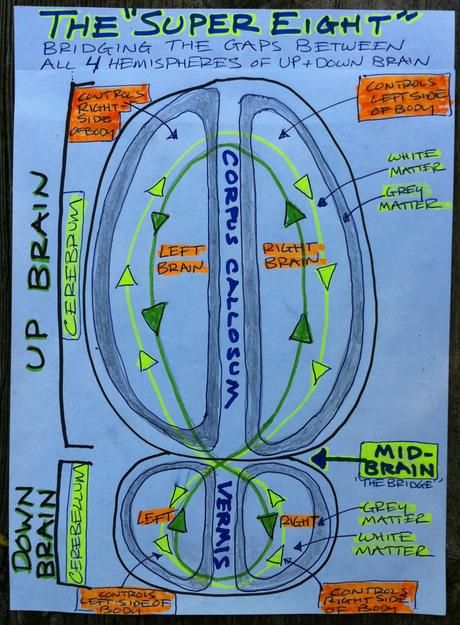
and we came up with the idea of shifting the focus of left brain-right brain to a new model
of up brain-down brain between the cerebrum and cerebellum. The cerebrum being the ‘conscious’ book brain, and the cerebellum being the ‘subconscious’ muscle memory brain.
At the time, I was trying to say that ‘left brain-right brain’ was wrong and that the salient divide
in the cranial globe was not east-west, but north-south between the 'up brain' (cerebrum) and 'down brain' (cerebellum). I realize now I may have been half right ... My hypothesis now is that all four hemispheres need to work together to optimize brain connectivity.
Again, this seems so obvious. I don't know why it took me so long to connect the dots.
The most recent neuroscientific research has confirmed that there really is a difference between
the left and right hemispheres. But I believe the goal for optimal brain connectivity isn’t
just across the corpus callosum of the cerebral hemispheres. Optimal brain function needs to include connectivity of the cerebellar hemispheres via the vermis (which divides the cerebellum)
and the midbrain which connects the "big brain" (cerebrum) with the "little brain" (cerebellum).
Beyond that I have a hunch that when the two hemispheres of the cerebrum
and the two hemispheres of the cerebellum become a ‘superfluid’ entity with zero friction
and zero viscosity your mind breaks free to another dimension of consciousness. When every cell of your brain, body, and mind are acting in perfect unison you are in a state of what I call superfluidity.
That split-brain model became the foundation of The Athlete’s Way. A few years later
when I was working on a book proposal for a book called “Origins of Imagination”
I started to notice that creative greats tended to make some type of physical activity
a part of their daily routine. I also noticed that the ‘eureka’ moments often happened
when the researcher, artist, writer... had stepped away from the microscope, canvas or typewriter. The ‘a-ha’ moments happened when a creative person was moving
or doing something that used implicit, cerebellar memory.
I also knew that as a writer I was similar to Joyce Carol Oates in that when I ran,
I could visualize and rework entire paragraphs, structure subheadings, and connect new ideas
in a way that I couldn’t when I was just sitting still. But what was the neuroscience of this?
I was kind of stumped until one day I was walking home and bumped into my friend Maria
on Commercial street in Provincetown. Maria is a poet and I was telling her about all the research
I was doing on the daily habits of creative people and how physical activity was a key
to creating ‘superfluidity’ of thinking.
Without missing a beat, Maria looked at me and said, “I ride the elliptical trainer for at least 40 minutes everyday. When I start moving my arms and legs back and forth the poetry just starts
to come out of me.” As she moved her arms and legs to emulate riding the elliptical
suddenly I realized that the bipedal motion was engaging all four hemispheres
and that connectivity optimized brain function and led to fluid intelligence.
I ran home and drew this diagram of the two hemispheres of the cerebrum and the two hemispheres of the cerebellum working together in what I call a "Super 8 Fluid Intelligence Loop." When you bring the cerebellum into the creative or 'intellectual' process,
crystallized thinking becomes more fluid (or superfluid on a good day).

Fine-Tuned Motor Skills Linked to Fluid Intelligence
On December 23, 2013 researchers in Switzerland announced that they had discovered
that humans with a higher “motor excitability”—which is linked to fine-tuned motor skills—
have  a better working memory, which is linked to improved fluid intelligence.
Researchers from the Psychiatric University Clinics (UPK Basel) and the Faculty of Psychology in Basel have found that the excitability of the motor cortex is directly linked
to improved working memory performance.
"The motor cortical excitability can be easily studied with transcranial magnetic stimulation,"
says Nathalie Schicktanz, doctoral student and first author of the study.
In the present study, that included 188 healthy young subjects, the scientists were able to show
that subjects with a high motor excitability had increased working memory performance as compared to subjects with a low excitability. "By measuring the excitability of the motor cortex, conclusions can be drawn as to the excitability of other cortical areas," says Schicktanz.
Over the past few years I have had my antennae up for any research that could prove this hunch.
It’s been very exciting to wake up every morning and see cutting edge research confirming the link between physical activity, motor skills and improved cognitive function.
I am still putting the pieces of this puzzle together but this new study from Switzerland
is one more piece towards solving this riddle.
The new study titled “Motor Threshold Predicts Working Memory Performance in Healthy Humans” was published December 2013 in Annals of Clinical and Translational Neurology. The research
was conducted by scientists from the Transfacultary Research Platform at the University of Basel.
 By measuring the motor excitability, were able to measure general cortical excitability
and related working memory and cognitive performance.

Conclusion: The Importance of Maintaining Working Memory Throughout Your Life
My first book was published a few months before my father passed away in 2007.
He died of a heart attack reading the New York Times in a reclining chair. When my sister and I
went to Florida to empty out his house we found stacks and stacks of my hardcover book in his study and copies of the book were scattered throughout the house.
I felt a sense of peace knowing that my father died knowing that I had published a book.
I believe that nobody should ever feel a ‘need for achievement’ or drive for perfection
in order to feel worthy of love and belonging. This is one reason I object to crystiallized intelligence standardized test scores dictating education. It's also why I make sure my daughter understands
that making an effort and pouring your heart into something that you love is all that really matters regardless of if you get a gold medal, an A+ or no recognition at all.
Interestingly, since my dad's death I feel as if he 'passed the torch' to me and I have such a joyful passion about carrying on his legacy as a neuroscientist. I wake up every morning eager to see
what researchers around the world are discovering about how the brain works and sharing that
with the general reader. As a neuroscientist, my father grew frustrated with the limitations of
bran imaging technology. Although there is still a long way to go,
he would be thrilled to see the advances made by things like the connectome project.
People of all ages need to keep their working memory strong in order to maintain fluid intelligence. In a sedentary digital age full of standardized testing, crystallized intelligence is monopolizing
our brains and causing some regions to shrink and become disconnected.
It causes me great concern for myself and my daughter's generation that people
—especially children—are totally out of balance between crystallized and fluid intelligence.
The book proposal I’m working on now is called “SUPERFLUIDITY: Daily Habits That Optimize Brain Connectivity for a Lifespan of Health, Happiness, and Personal Bests” and is geared towards
upping the fluid intelligence quotient for people from all walks of life and generations.
https://www.psychologytoday.com/blog/the-athletes-way/201312/too-much-crystallized-thinking-lowers-fluid-intelligence

Turbo Charged Reading:  Read More>>>Read fast>>>Remember more>>>Years later
Contact M’reen at: read@turbochargedreading.com

You can TCR specialist and language dictionaries that are spontaneously accessed.
I can Turbo Charge Read a novel 6-7 times faster and remember what I’ve read.
I can TCR an instructional/academic book around 20 times faster and remember what I’ve read.
Introduction to Turbo Charged Reading YouTube
A practical overview of Turbo Charged Reading YouTube 
How to choose a book. A Turbo Charged Reading YouTube
Emotions when Turbo Charged Reading YouTube

Advanced Reading Skills Perhaps you’d like to join my FaceBook group ?

Perhaps you’d like to check out my sister blogs:
www.innermindworking.blogspot.com        gives many ways for you to work with the stresses of life
www.ourinnerminds.blogspot.com              which takes advantage of the experience and expertise of others.
www.happyartaccidents.blogspot.com       just for fun.

To quote the Dr Seuss himself, “The more that you read, the more things you will know.
The more that you learn; the more places you'll go.”

Saturday, 4 February 2017

3 Ways to Improve Memory

Crane's bill.

3 Ways to Improve Memory
Ray Lumpp

The human brain is one of the most mysterious and powerful tools in the modern world.
This magical organ interprets reality through synapses and neurons, forming subjective thoughts, qualities, and memories, which form our identities. Using up to twenty percent of the energy
we consume, our brain is always working and always changing. As we grow, the connections between regions of the brain reinforce each other, fortifying our memory, until a certain age
at which, either naturally, through “disuse,” or through memory loss diseases such as Alzheimer’s,
we begin to lose control of our memories. But we are not necessarily doomed to forget
our brief passage through this life before our brain finally shuts down:
here are three ways you can enhance your memory through lifestyle changes.

1. Self-Awareness
Understanding how your brain makes memories is crucial to improving memory function.
As you experience the world, the sensory information received is encoded through your short-term memory—visually, acoustically, and semantically—and stored in various regions of your brain
with your working memory. Through the long-term process of recollection, your brain reconstructs   the memory from storage, meaning that the more times you access a memory,
the more likely it is to change (the opposite is true of “commonplace” memories
which you rarely revisit, such as this morning’s shower, yesterday’s commute, etc.).
The act of recollecting is a helpful exercise in improving memory itself.
What you notice in certain memories upon recalling them also affects their ability to be recalled. Becoming aware of what draws your attention to certain memories and choosing to focus
on different points of view can force your brain to make new associations, 
strengthening your neural network and placing the memory in a context.
 Keeping a journal is possibly the best way to improve self-awareness, but literal self-awareness
with mirrors, cameras, microphones, or audiences also improve the accuracy of memory.
Our memories fade with old age because our brain becomes less effective at encoding and retrieval as we discontinue learning. Learning and socialization arouse various parts of the brain
—language, perception, problem-solving, motor coordination—all at once, and are undoubtedly
the cornerstones of a bright, sharp, longitudinal memory.

2. Stress Reduction
Stress has a significant detrimental effect on memory formation. If any strong emotion is present during an event, the neurons active during this event produce strong connections with each other. When the event is recalled, the neurons will more easily and speedily make the same connections (which can be disastrous for those suffering from PTSD or drug addiction withdrawal).
These memories also tend to be warped or focused on extreme details rather than
the greater context of the scene—another way self-awareness can promote healthy memories.

Get plenty of sleep! Neuroimaging studies have shown activation patterns in the sleeping brain which mirror those recorded during the learning of tasks from the previous day,
suggesting that new memories may be solidified through such rehearsal.
Coupled with a nightly recollection of the day prior, or even a dream journal,
sleep can be a very powerful tool for managing memories.

Meditation, a form of mental training to focus attention, also seems to increase the control
over brain resource distribution, improving both attention and discipline.
The changes are potentially long-lasting, as meditation may have the ability to strengthen
neuronal circuits as selective attentional processes improve.

Playing music also improves various aspects of memory through abstract connections in the brain between acoustic, semantic, and language-processing regions. Research shows that children
who participated in one year of instrumental musical training showed improved verbal memory, whereas no such improvement was shown in children who discontinued musical training.

3. Diet and Exercise
Exercise has been shown to improve cognitive performance on encoding and retrieval
of information, and has been found to regulate hippocampal neurogenesis,
which promotes the survival of newborn neurons and helps form new memories.
Physiological activity also provides the brain increased blood-flow and oxygen levels,
which, along with the right diet, keep the brain healthy.
There are many “brain foods,” but only a certain group of fruits and vegetables provide direct benefits to the facilitation and maintenance of memory processes—flavonoids.
Flavonoids are photochemicals found in plant-based foods and valued for their antioxidant properties,  and are found in onions, leeks, broccoli, parsley, celery, soybeans, citrus fruits,
berry fruits, tomatoes, green teas, red wines, and cocoa.
Glucose also plays an important role in improving memory, as it can pass from blood to the brain, providing energy and boosting neural metabolism.
Excess intake levels of fat and calories are harmful to memory function.
Saturated fats and cholesterol are especially high-risk foods for the onset of Alzheimer’s,
not to mention the myriad other health risks associated with these food groups.

http://www.lifehack.org/articles/lifestyle/3-ways-to-improve-memory.html

Turbo Charged Reading: Read more>>>Read fast>>>Remember more>>>Years later
Contact M’reen at: read@turbochargedreading.com

You can TCR software and engineering manuals for spontaneously recall – or pass that exam.
I can Turbo Charge Read a novel 6-7 times faster and remember what I’ve read.
I can TCR an instructional/academic book around 20 times faster and remember what I’ve read.
Introduction to Turbo Charged Reading YouTube
A practical overview of Turbo Charged Reading YouTube  
How to choose a book. A Turbo Charged Reading YouTube
Emotions when Turbo Charged Reading YouTube

Advanced Reading Skills Perhaps you’d like to join my FaceBook group ?

Perhaps you’d like to check out my sister blogs:
www.innermindworking.blogspot.com        gives many ways for you to work with the stresses of life
www.ourinnerminds.blogspot.com              which takes advantage of the experience and expertise of others.
www.happyartaccidents.blogspot.com       just for fun.

To quote the Dr Seuss himself, “The more that you read, the more things you will know.
The more that you learn; the more places you'll go.

Saturday, 28 January 2017

13 Signs You’re A Pretty Quick Learner

Hera by M'reen

13 Signs You’re A Pretty Quick Learner
Casey Imafidon

According to a study it is discovered that fast learners (specifically language learners)
have more white matter and less symmetrical brains.
Learning fast or being a quick learner depends on how we use our brains.
Sometimes what seem so sophisticated needs the simplest solution.
Here is how to know if you are a pretty quick learner.

1. You are not afraid to say “I don’t know”
Pretty quick learners accept that they do not know it all.
They keep their minds open and are willing to ask questions and quiz for answers to know more. While some are reluctant are hesitant to show their ignorance on a subject, quick learners are not.

2. You use the Pareto principle
Quick learning has productivity attached to it. According to Vilfredo Pareto you get 80%
of your results from 20% of the things you do. Quick learners make use of this principle
by focusing on the fundamental and the most used items in a series of difficult tests. They don’t chase after the whole bunch at once but major their strength on the most necessary ones first.

3. You are able to visualize it
When dealt with problems, quick learners are multidimensional.
 They take advantage of how to deal with it with all their senses.
They visualize it by taking advantage of their mental powers to drive solutions and learning.

4. You simplify
Quick learners know that difficult problems do not need a difficult approach.
Many great minds from Thomas Edison to Henry Ford and even Steve Jobs looked for ways
to address challenges with simple solutions. They simplify and immerse themselves in their goals
to find the easiest and simplest way out of a hole.

5. You take action
After all is said and done, at the end of the day it is up to you to take action.
If you are learning a new language you really cannot make so much progress
if you do not speak the new language, whether you get it right or not.
Quick learners learn by doing and taking decisive action.

6. You are selective
You do not go after all the possible explanations or solutions to a problem. Rather you take your time to broadly consider those that are worthy of your attention and assessment.
Through this you are able to go after the most promising solutions available.

7. You use Parkinson’s Law
Tim Ferris, author of The 4-Hour Work Week points out that much can be gained by combining
the use of Parkinson’s law and Pareto’s principle to achieve solutions and learn faster.
While Pareto’s principle means streamlining to get more out of your time, Parkinson’s Law 
means you limit the time for learning so as to gain only the most important things.
Quick learners only allocate enough time to grasp only the most important part of a topic
and waste no time on the less important parts.

8. You know when to stop
Quick learners know when to stop and not to proceed.
If something is not going in an answerable pattern, they retreat. They understand the law
of diminishing returns and focus on only things that provide a return on their investment.

9. You know how to anticipate the future
What becomes old and stale is of no use to a quick learner;
rather they have to be able to adapt and anticipate future trends and situations.
You can focus on the future and how you can apply every topic you are learning to it.

10. You understand that many questions have no answers
Through selection you already have a sense of not going after the wrong questions or topics.
You already know that when a question is complicated and has so many threads attached to it,
there probably is no solution for it.

11. You can explain it to a kid
After immersing and absorbing yourself in a topic,
you can communicate your thoughts and opinions on the subject matter (even to a kid).

12. You are positive
Quick learners do not show any negative attitude to learning what is important to them.
They are positive even when they are faced with setbacks and challenges.

13. You can seek the opinions of experts
You know there are people who are better than you on a subject.
Nobody learns so much without dedicating themselves to the tutelage of a master!

http://www.lifehack.org/articles/productivity/13-signs-youre-pretty-quick-learner.html

Turbo Charged Reading: Readmore>>>Read fast>>>Remember more>>>Years later
Contact M’reen at: read@turbochargedreading.com

You can TCR music, poetry or self development material for internal knowing.
I can Turbo Charge Read a novel 6-7 times faster and remember what I’ve read.
I can TCR an instructional/academic book around 20 times faster and remember what I’ve read.
Introduction to Turbo Charged Reading YouTube
A practical overview of Turbo Charged Reading YouTube  
How to choose a book. A Turbo Charged Reading YouTube
Emotions when Turbo Charged Reading YouTube

Advanced Reading Skills Perhaps you’d like to join my FaceBook group ?

Perhaps you’d like to check out my sister blogs:
www.innermindworking.blogspot.com         gives many ways for you to work with the stresses of life
www.ourinnerminds.blogspot.com               which takes advantage of the experience and expertise of others.
www.happyartaccidents.blogspot.com        just for fun.

To quote the Dr Seuss himself, “The more that you read, the more things you will know.
The more that you learn; the more places you'll go.”

Sunday, 22 January 2017

Erin Brockovich - Breaking out of the box.

Yellow Rattle.


Turbo Charged Reading: Read more>>>Read fast>>>Remember more>>>Years later
Contact M’reen at: read@turbochargedreading.com

You can TCR specialist and language dictionaries that are spontaneously accessed.
I can Turbo Charge Read a novel 6-7 times faster and remember what I’ve read.
I can TCR an instructional/academic book around 20 times faster and remember what I’ve read.
Introduction to Turbo Charged Reading YouTube
A practical overview of Turbo Charged Reading YouTube  
How to choose a book. A Turbo Charged Reading YouTube
Emotions when Turbo Charged Reading YouTube

Advanced Reading Skills Perhaps you’d like to join my FaceBook group ?

Perhaps you’d like to check out my sister blogs:
www.innermindworking.blogspot.com        gives many ways for you to work with the stresses of life
www.ourinnerminds.blogspot.com              which takes advantage of the experience and expertise of others.
www.happyartaccidents.blogspot.com       just for fun.

To quote the Dr Seuss himself, “The more that you read, the more things you will know.
The more that you learn; the more places you'll go.”   

Monday, 16 January 2017

How to Read a Book for Maximum Learning

Thistle and tesal.


Turbo Charged Reading: Read more>>>Read fast>>>Remember more>>>Years later
Contact M’reen at: read@turbochargedreading.com

You can TCR software and engineering manuals for spontaneously recall – or pass that exam.
I can Turbo Charge Read a novel 6-7 times faster and remember what I’ve read.
I can TCR an instructional/academic book around 20 times faster and remember what I’ve read.
Introduction to Turbo Charged Reading YouTube
A practical overview of Turbo Charged Reading YouTube  
How to choose a book. A Turbo Charged Reading YouTube
Emotions when Turbo Charged Reading YouTube

Advanced Reading Skills Perhaps you’d like to join my FaceBook group ?

Perhaps you’d like to check out my sister blogs:
www.innermindworking.blogspot.com         gives many ways for you to work with the stresses of life
www.ourinnerminds.blogspot.com               which takes advantage of the experience and expertise of others.
www.happyartaccidents.blogspot.com        just for fun.

To quote the Dr Seuss himself, “The more that you read, the more things you will know.
The more that you learn; the more places you'll go.